.png)

Through Children’s Eyes: A Lesson for the World
- kriskonieczny
- Jan 19
- 3 min read
Witnessing kindness, creativity, and the quiet power of wonder from children.




Lately, the world feels loud, heavy, and uncertain. There is so much anger, so much urgency, and so much pulling at our attention. Amid it all, I have realized how deeply grateful I am for the opportunity to step away from that noise and enter the world of children, even if only for a few hours each day. To slow down. To notice. To see joy and innocence in ways I had almost forgotten were possible.
In these quiet moments, I am reminded that learning does not always come from rushing or striving. It comes from observing, listening, and being present. When I slow down and look alongside children, light becomes language, and learning becomes visible.
In the atelier, we are two weeks into our exploration of light and color, and already the children are showing me just how deeply they notice the world. They see beauty in ways I often miss. While observing colored glass, one child softly shared, “It changes when I move.” Another added, “Look what we can do!” Their observations are careful, intentional, and full of wonder; and they naturally invite one another into seeing and thinking together.
As we begin this study, we are spending time with the work of artist Dale Chihuly. When I introduce an artist, I always start with the same question: What is an artist? What does an artist do?
“They paint.”
“They build.”
“They use loose parts like we do.”
“I’m an artist… you’re an artist!”
That shared understanding feels grounding. In a world that often tells us otherwise, these children know themselves as creators and are confident in that knowledge. I am deeply grateful that my work is to honor that identity and witness children learning from each other, helping each other, and celebrating each other along the way.
When the children first encountered Chihuly, one child studied his image and confidently announced, “He’s a pirate and an artist, look at his eye patch!” Another added, “Pirates make treasures.” Their thinking reminds me that imagination and reality can live side by side, and that joy often appears in the smallest, unassuming ways. In their shared observations and gentle reminders, children model patience and care for one another, quietly practicing a community of respect.
Across the atelier, children are exploring Chihuly’s work through materials, light, and collaboration. The twos are painting blocks of ice, noticing how ice behaves like glass. “It’s cold, it's shiny,” one child observed, while another looked at their work and whispered, “This is amazing.” Often, they pause to show their neighbor or celebrate a shared discovery.
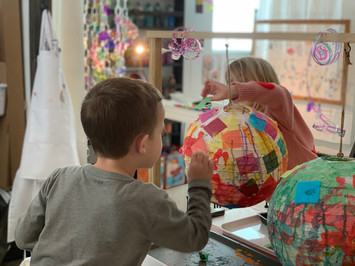
Three-year-olds and Pre-K children collaborate, painting and gluing semi-translucent papers onto lanterns. As light passes through their work, they pause and reflect together: “It’s glowing,” “Mine looks like the sun,” and “Let’s put our colors together.” They learn to negotiate space, take turns, and offer encouragement: a small, beautiful example of cooperation and kindness in action.
KR and Kindergarten children are adding color to recycled plastic, knowing their pieces will eventually become part of a larger sculpture. “If we hang it this way, the light can get through,” one child suggested. Another wondered aloud, “What happens if we use only black?” In these moments, children listen, respond, and build on one another’s ideas, showing that collaboration can be joyful, intentional, and meaningful.
All of the children are contributing to a shared hanging installation. Chains hang from the ceiling as children choose translucent and semi-translucent materials, colored plastics, beads, wire, and hooks. At the center, a table of lights invites experimentation. “Turn it brighter,” one child called out, while another noticed, “Look, it’s dancing on the wall.” And another offers, "I'll help you hang it!" As they work together, children naturally listen, offer help, and celebrate each other’s choices. Their collaboration is kind, patient, and joyful, a true sense of community that feels all the more remarkable in a world where such care can seem so rare.
Children are also closely observing colored glass bottles, sketching what they see, and adding watercolor. “I’m drawing the light, not the bottle,” one child explained. They often share their sketches with each other, comparing colors, shapes, and reflections, learning to notice and appreciate different perspectives in a respectful, supportive way.
This study is still unfolding. I am listening closely, knowing it may conclude next week or continue for many weeks to come. It is a dance of collaboration and respect, guided by the desires and intentions of each child.
In a world that often feels fractured, I am profoundly grateful for the chance to spend my days in spaces where curiosity, kindness, and wonder remain our guides. If hope lives anywhere, it is here, in children’s questions, their careful looking, and their quiet belief that the world can still be a beautiful place.


Comments